



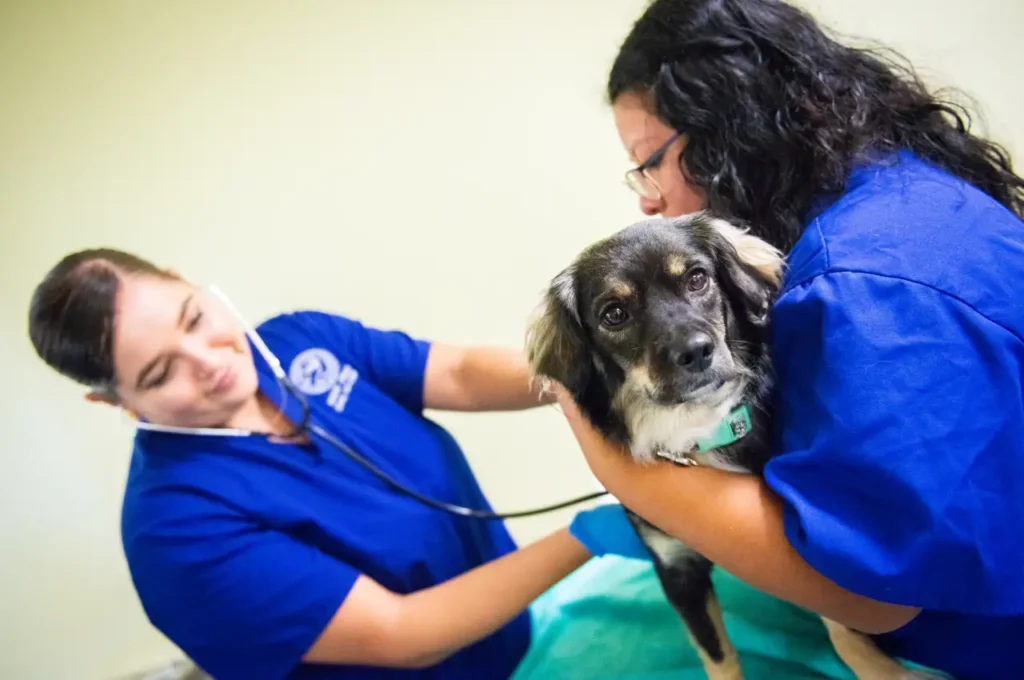
If you know you want to work with animals but are not sure which veterinary career to pursue, two job titles can quickly become confusing: veterinary assistant and veterinary technician.
Both work alongside veterinarians. Both may interact directly with animals and pet owners. Both can work in veterinary clinics and animal hospitals. But they are not the same career.
The biggest differences between a veterinary assistant and veterinary technician involve the level of clinical responsibility, education required, credentialing, scope of practice, and earning potential.
A veterinary assistant can often enter the field through a shorter training pathway and focus on animal care and clinic support. A veterinary technician generally completes formal veterinary technology education and takes on more advanced clinical and diagnostic responsibilities.

Here is how the two careers compare—and what prospective veterinary professionals in California should know before choosing a path.
Quick Answer: A veterinary assistant generally supports veterinarians and veterinary technicians with animal care, restraint, preparation, sanitation, client communication, and daily clinic operations. A veterinary technician typically receives substantially more formal education and may perform advanced clinical tasks such as laboratory testing, radiography, anesthesia monitoring, and medication administration under veterinarian supervision.
Veterinary Assistant vs. Veterinary Technician: Quick Comparison
Before looking at each career in detail, this quick comparison highlights the main differences between a veterinary assistant and veterinary technician, including training, responsibilities, credentials, and salary.
| Category | Veterinary Assistant | Veterinary Technician |
|---|---|---|
| Primary role | Animal care and clinical support | Technical and clinical animal healthcare |
| Typical entry-level education nationally | High school diploma plus on-the-job training; formal training may strengthen preparation | Usually an associate degree in veterinary technology |
| Credential required | Generally no veterinary technician license | Typically credentialing required; California uses the RVT designation |
| Typical responsibilities | Restraint, feeding, cleaning, preparation, basic patient support, client assistance | Lab testing, radiography, anesthesia monitoring, medication administration and advanced nursing duties |
| Length of training | May be significantly shorter | Commonly around two years for a veterinary technician degree |
| National median pay, May 2025 | $38,150* | $47,380* |
| U.S. job outlook, 2025–2035 | 9% growth* | 9% growth* |
| Good fit for | Someone seeking a faster entry into animal healthcare | Someone seeking broader clinical responsibilities |
Both careers can provide opportunities to work closely with animals, but they differ significantly in education and clinical responsibility. Understanding these differences can help you choose the path that better matches your career goals.
Discover Career Opportunities in Healthcare
CHAC helps students gain practical skills and knowledge to prepare for careers in the healthcare industry.
Discover Programs →Veterinary Assistant vs. Vet Tech Duties: Where Is the Line?
This is where prospective students often become confused.
Veterinary assistants and veterinary technicians frequently work side by side, so some of their daily activities may look similar from the outside.
However, being present during a medical procedure is not the same as being legally authorized to perform every part of that procedure.
For example, in California, unlicensed veterinary staff are considered veterinary assistants. They may perform permitted supporting tasks under appropriate supervision, but they cannot perform duties reserved for veterinarians, Registered Veterinary Technicians or certain permit holders.
California RVTs have a broader authorized scope. Depending on the task and supervision level, the California Veterinary Medical Board identifies duties that may include administering anesthesia, operating radiographic equipment, drawing blood, running laboratory tests, administering medications and performing certain additional procedures.
That legal distinction makes training and credentials especially important.
A simple way to remember the difference
Veterinary assistant: helps support the patient, veterinary team and clinical environment.
Veterinary technician: performs a wider range of technical animal-healthcare procedures under veterinarian supervision.

What Does a Veterinary Assistant Do?
A veterinary assistant helps keep the veterinary team, animals, and daily clinic workflow moving.
Imagine a busy animal hospital on a Monday morning.
One dog needs to be safely positioned for an examination. A treatment area needs to be prepared for the next patient. Kennels need to be cleaned and disinfected. Supplies need to be organized. A nervous pet owner may need help understanding what happens next.
Veterinary assistants often help with these essential behind-the-scenes responsibilities.
Depending on the employer, training, state regulations, and level of supervision, veterinary assistant duties may include:
- Helping safely handle and restrain animals
- Feeding, weighing and caring for animals
- Cleaning and disinfecting kennels and treatment areas
- Preparing examination or treatment rooms
- Cleaning and sterilizing equipment
- Preparing animals or supplies for procedures
- Maintaining animal care records
- Supporting veterinarians and veterinary technicians
- Communicating with pet owners
- Assisting with front-office or administrative responsibilities
The U.S. Bureau of Labor Statistics describes veterinary assistants and laboratory animal caretakers as professionals who provide routine animal care and help veterinarians and others complete daily tasks.
That description may sound simple, but veterinary clinics depend heavily on people who can handle animals safely, follow instructions carefully, communicate professionally, and remain organized in an unpredictable environment. Gain practical skills and hands-on experience through CHAC’s Veterinary Assistant training program.
Build Your Future as a Veterinary Assistant
What Does a Veterinary Technician Do?
A veterinary technician, often called a vet tech, generally works at a higher clinical level.
A useful comparison is that veterinary technicians support veterinarians through skilled nursing, diagnostic and technical tasks.
According to the U.S. Bureau of Labor Statistics, veterinary technicians may:
- Observe animals’ behavior and condition
- Provide nursing care and emergency first aid
- Restrain animals during examinations or procedures
- Collect samples and perform laboratory testing
- Take radiographs
- Prepare animals and instruments for surgery
- Administer veterinarian-prescribed medications or vaccines
- Assist with anesthesia and monitor animals
- Record patient histories
- Help communicate medical information to animal owners
Their exact duties depend on state law and veterinarian supervision. This greater clinical responsibility is one of the most important distinctions in the veterinary technician vs. veterinary assistant comparison.
Veterinary Assistant vs. Veterinary Technician: Which Path Fits Your Goals?
Rather than asking which career is universally “better,” consider what you actually want from your first step into veterinary healthcare.
Veterinary Assistant May Fit You If You:
- Want a shorter educational pathway
- Want to enter an animal-care environment sooner
- Prefer practical, hands-on learning
- Want experience before committing to a longer degree
- Enjoy supporting a team
- Want regular interaction with animals
- Are interested in veterinary medicine but are still exploring your long-term direction
Veterinary Technician May Fit You If You:
- Want deeper clinical responsibilities
- Are prepared to complete a longer educational program
- Are comfortable with science-intensive coursework
- Want to perform more advanced diagnostic and nursing procedures
- Are willing to complete credentialing requirements
- Want opportunities to pursue specialized technical areas later
There is no single answer for everyone. Your available time, finances, career goals and comfort with clinical responsibility should all influence the decision.
What Veterinary Assistant Training Looks Like at CHAC
For students in Southern California who decide that veterinary assisting is the right starting point, training can be more useful when it extends beyond reading about animal care.
The Veterinary Assistant program at California Healing Arts College (CHAC) is designed around hands-on career preparation.
The current program includes training involving areas such as:
- Animal handling and restraint
- Feeding and basic nursing care
- Surgical preparation
- Patient monitoring
- Veterinary equipment
- Radiography-related skills
- Animal-care procedures
Students also complete a 240-hour externship at an affiliated veterinary site, providing exposure to real animals, clients and veterinary workflows. The program is listed as 36 weeks.
CHAC’s Veterinary Assistant program is based at its Carson, California campus, serving students from Southern California communities. CHAC is accredited by ACCSC and approved to operate by California’s BPPE.
Build Your Future as a Veterinary Assistant
Gain practical skills and hands-on experience through CHAC’s Veterinary Assistant training program.
Learn More About the Program →Why the externship matters
Reading how to restrain an animal is different from safely handling one.
Studying clinic communication is different from meeting an anxious pet owner.
Learning what happens in an animal hospital is different from becoming part of its daily workflow.
That is where practical veterinary training becomes especially valuable.